

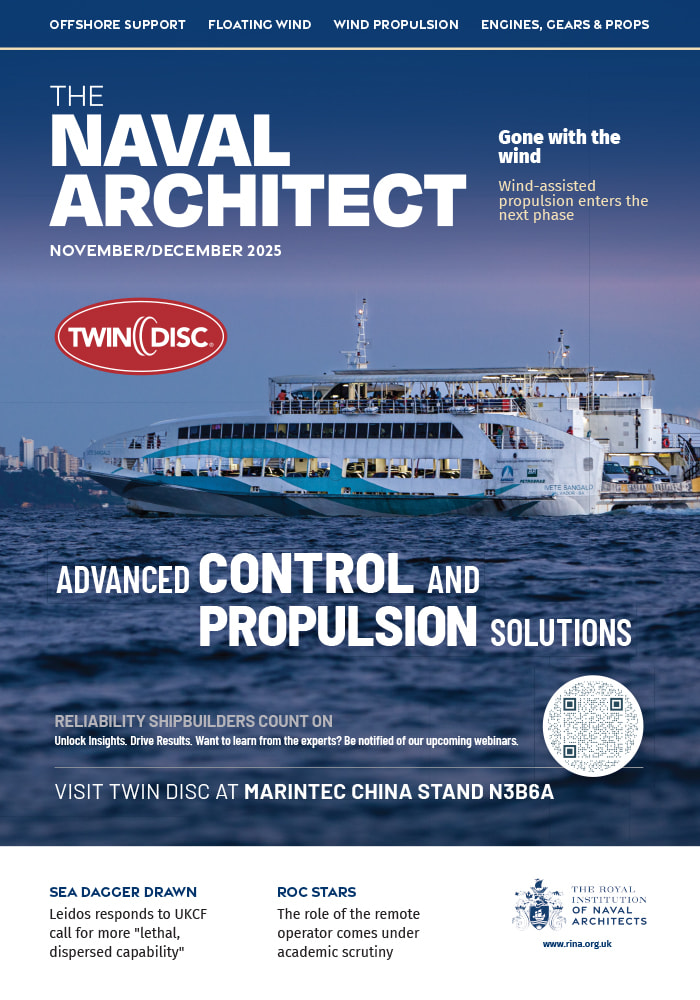
November/December 2025
The last issue of this year's Naval Architect is now available to read online and in print. Highlights from this issue:
Offshore Support
Floating Wind
Wind Propulsion
Engines, Gears & Props
Want to keep up to date with the latest news and developments in the maritime industry? Full articles and in-depth analysis are exclusively available to all RINA members & subscribers.
Autonomous Ships 2020 Conference Proceedings
Autonomous Ships
Damaged Ship 2020 Conference Proceedings
Damaged Ship
This is the Whole Conference Proceedings for: Damaged Ship V, 11th March 2020, London, United Kingdom
High Speed Vessels 2020 Conference Proceedings
High Speed Vessels
This is the Whole Conference Proceedings for: High Speed Vessels, 1st - 2nd July 2020, London, United Kingdom
High Speed Vessels 2020 Conference Proceedings
Historic Ships
This is the Whole Conference Proceedings for: Historic Ships, 2nd - 3rd December 2020, London, United Kingdom
Human Factors 2020 Conference Proceedings
Human Factors
This is the Whole Conference Proceedings for: Human Factors, 19th - 20th February 2020, London, United Kingdom
Ice Class Vessels 2020 Conference Proceedings
Ice Class Vessels
This is the Whole Conference Proceedings for: Ice Class Vessels, 4th November 2020, London, United Kingdom
Marine Design 2020 Conference Proceedings
Marine Design
This is the Whole Conference Proceedings for: Marine Design, 15th - 16th January 2020, Cadiz, Spain
Smart Ship Technology 2020 Conference Proceedings
Smart Ship Technology
This is the Whole Conference Proceedings for: Smart Ship Technology Conference, 14th - 15th October 2020, Online
LNG BUNKER VESSEL DESIGN AND OPERATION
Alternative Fuels
Liquefied natural gas bunkering is creating a new class of maritime support vessel. Drawing on extensive experience in floating LNG infrastructure and gas carrier design, engineers are developing robust bunker-vessel concepts to enable global fuel supply networks. The trend highlights LNG’s transitional role in shipping’s pathway toward lower-carbon operations worldwide.
EVALUATION OF LNG CRYOGENIC ENERGY UTILIZATION IN SEAWATER DESALINATION ON LNG FUELLED SHIPS
Alternative Fuels
Recovering LNG cryogenic energy for onboard freshwater production could significantly improve the sustainability of LNG-fuelled vessels. By integrating atmospheric water generation and distillation systems with regasification processes, researchers achieved notable efficiency gains and reduced energy consumption. The concept demonstrates a practical approach to resource recovery, operational efficiency, and maritime decarbonisation overall.
CONVERSION OF AN LNG CARRIER TO FLOATING STORAGE AND REGASIFICATION UNIT
Alternative Fuels
LNG carrier conversions are emerging as a faster, lower-cost route to expanding gas import infrastructure. By transforming existing vessels into floating storage and regasification units, operators can significantly reduce capital expenditure and deployment timelines. The approach strengthens energy security, improves market responsiveness, and supports growing global natural-gas demand efficiently today.
LNG BUNKERING VESSELS AND BARGES: A 2020 UPDATE
Alternative Fuels
Dedicated LNG bunkering vessels and barges are rapidly expanding to support growing adoption of gas-fuelled shipping. Tracking successive generations of newbuilds and conversions, the analysis highlights evolving transfer capabilities, specialised fuel-handling systems, and accelerating global infrastructure development. The trend underscores LNG’s emerging role in lower-emission maritime operations worldwide today ahead.