

Simple physics with a significant impact
A new technology originally conceived to improve the performance of offshore racing powerboats has evolved into a solution for reducing the vertical accelerations experienced by crew and passengers operating at speed.
Salmon Marine is supplying one of its Wavebreaker dynamic ballast systems for a new 9m aluminium-hulled search and rescue craft under construction by Dutch boatbuilder Habbeke for the UK’s Southport Independent Lifeboat.
How it works
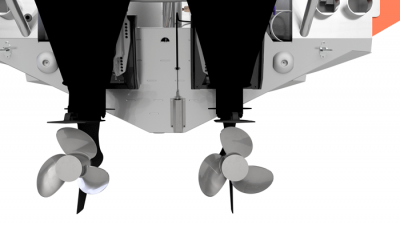
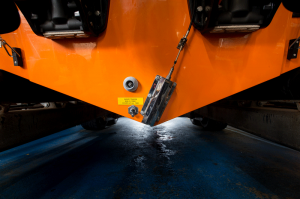
A pick-up valve mounted low on the transom admits seawater into a vented ballast tank positioned well forward in the bow.
Once the vessel exceeds approximately 12knots, the pressure generated beneath the hull rapidly fills the tank with seawater. On a vessel travelling at around 35knots, water enters at approximately 10litres per second, allowing a typical 300litre tank to fill in around 30 seconds.
Emptying the tank uses exactly the same valve. The forward motion of the boat allows the water to drain back through the transom outlet, typically taking around one minute to empty the same 300litre tank at 35knots. Valve operation is via a conventional Morse cable, usually connected to a simple console-mounted lever.
 |
|---|
To maximise effectiveness, the bow ballast tank is normally fitted with internal baffles to minimise free-surface effects when partially filled. On new construction projects, the tank can be incorporated directly into the hull structure.
In GRP or aluminium craft, it is laminated into the bow during manufacture, while aluminium builders such as Habekke simply weld the tank into the hull as part of the fabrication process.
For retrofits, Salmon Marine supplies the valve system, while for newbuilds or retrofits, it can provide HDPE tanks as part of the offering, with the option of integrating into the hull structure.
Forces at work
From a naval architectural perspective, the effectiveness of the Wavebreaker system lies not simply in adding weight, but in dynamically altering the vessel's longitudinal centre of gravity (LCG) to influence its motion through a seaway.
In planing craft at speed, excessive bow-up trim can encourage the vessel to launch from wave crests before re-entering the water with high impact velocities.
It is these repeated slam events that generate the large vertical accelerations associated with crew fatigue and long-term musculoskeletal injury.
Introducing several hundred litres of seawater into a ballast tank positioned at the extreme forward end of the hull shifts the LCG appreciably forward.
 |
|---|
Although the ballast represents only a modest percentage of the vessel's displacement, its long lever arm ahead of the original LCG produces a disproportionately large trimming moment.
The result is a flatter running attitude, reducing both pitch amplitude and the likelihood of the bow becoming completely airborne between successive waves.
Reducing vertical velocity
Maintaining more continuous contact between the hull and the water effectively reduces the vessel's vertical velocity before impact.
Since slamming loads are strongly influenced by impact velocity, even relatively small reductions in hull flight time can produce significant decreases in peak vertical accelerations experienced throughout the craft.
Independent testing performed by a research team at the University of Southampton, in cooperation with the UK’s Royal National Lifeboat Institution (RNLI), demonstrated the effectiveness of the Wavebreaker system on a 7.5m SAR RIB. Mean vertical bow acceleration in the potentially highly injurious Z-axis was reduced by 50%, while the peak forces from the most dangerous slam events were reduced by approximately 70%.
The RNLI has long employed the system throughout its Atlantic 75 and Atlantic 85 rigid inflatable lifeboat fleets, while the Royal Netherlands Sea Rescue Institution (KNRM) also specified the technology after acquiring former RNLI Atlantic 75s.
When those vessels reached replacement age, a working group of coxswains, technical specialists and consultants unanimously requested that the replacement craft, built by Stormer Marine, should also incorporate the Wavebreaker system.
Origin story
The technology was originally designed and developed by Steve Salmon, an engineer, machinist and inventor based in Poole, Dorset, whose side business involved some fabrication work for offshore powerboat racing teams.
His ballast system began as something of a passion project rather than a commercial product.
Steve Salmon passed away in 2014. His son Joe, who initially had little involvement with the marine industry, subsequently took over the business, refined the design and recognised its growing relevance for shock mitigation.
Broader strategy
Joe Salmon is careful to present Wavebreaker as one element within a broader shock mitigation strategy rather than as an alternative to suspension seating.
 |
|---|
“Modern suspension seats remain highly effective at isolating seated crew members from vertical impacts. However, suspension seating can only protect those occupying the seats,” he says.
In search and rescue scenarios, casualties may be lying horizontally on stretchers, crew may be moving around the deck, and crew members often spend considerable periods standing while assessing casualties or preparing equipment. None of these people can benefit directly from seat suspension.
By reducing the overall accelerations experienced by the entire hull, the Wavebreaker system protects everyone aboard regardless of where they are positioned or what task they are performing.
Suspension seats provide an additional level of protection for the crew during prolonged high-speed passages. However, depending upon vessel configuration, the complete Wavebreaker installation can cost somewhat less than a single premium suspension seat while benefiting every person aboard rather than only one occupant.
Wider application
Looking ahead, the concept may also find applications beyond crewed vessels. Salmon Marine is already working on an uncrewed surface vessel project where the primary objective is not protecting people but safeguarding delicate and expensive onboard sensor payloads from repeated shock loading.
For naval architects and marine engineers, the Wavebreaker system serves as a reminder that innovation does not always require increasing complexity. By exploiting nothing more than hydrodynamic pressure and thoughtful weight distribution, measurable improvements in ride quality can be delivered.
| Article Tags | |
| Article Tags | |
| Naval Architect Edition | |
| Naval Architect Edition | |
| General | |
| Preview Text | A new technology originally conceived to improve the performance of offshore racing powerboats has evolved into a solution for reducing the vertical accelerations experienced by crew and passengers operating at speed. Salmon Marine is supplying one of its Wavebreaker dynamic ballast systems for a new 9m aluminium-hulled search and rescue craft under construction by Dutch boatbuilder Habbeke for the UK’s Southport Independent Lifeboat. How it works A pick-up valve mounted low on the transom admits seawater into a vented ballast tank positioned well forward in the bow. Once the vessel exceeds approximately 12knots, the pressure generated beneath the hull |