

Engineering flexibility into hybrid ferry design
A close working relationship is being forged between Incat and battery integrator Echandia, on a new 78m hybrid ferry design.
The new vessel has been designed to maximise operational flexibility while reducing operating expenditure and supporting a practical transition away from fossil fuels.
Carrying up to 650 passengers and 120 cars at speeds of 28knots, the catamaran can operate in fully electric, hybrid or generator-only modes, enabling zero-emission operation on short routes and in emission-control zones while maintaining range on longer crossings.
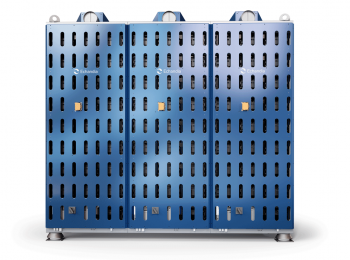
Its modular platform allows battery capacity to be expanded throughout the vessel's service life using Echandia's lithium titanate oxide (LTO) Core battery system.
A collaborative approach
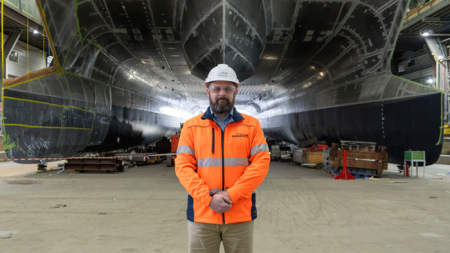
The vessel design project was led by Jason McVicar, design manager, Revolution Design.
Revolution Design serves as the exclusive in-house naval architecture, engineering and design team for Incat.
McVicar says that the development of this vessel reflects the increasingly collaborative nature of modern ship design.
 |
|---|
"As vessels become more sophisticated and operators seek greater flexibility to reduce emissions while maintaining performance, it's essential that shipbuilders, naval architects and technology partners work closely together from the earliest stages of a project," he says.
Rather than designing around a single operating scenario, the focus was on creating an adaptable platform balancing performance, efficiency, payload and operational capability.
The propulsion, electrical architecture and onboard systems have been developed as an integrated package meeting the highest standards of safety, reliability and class compliance.
"Taking a holistic approach considers the vessel as a complete package, with the propulsion, electrical architecture and onboard systems all developed to work together while meeting the highest standards of safety, reliability and class compliance,” notes McVicar.
The project also marks Echandia's first order with Incat.
McVicar adds that the collaboration with Echandia has been an important part of the design process.
"Integrating the battery system into the overall vessel design has enabled us to deliver a solution that not only meets today's operational requirements but also supports future flexibility as battery technology and operator requirements continue to develop."
Battery integration
Echandia became involved at a late equipment-integration stage. By that point, the principal structural design, machinery arrangement and weight distribution had already been established, and the vessel's structure was complete.
Felix Backgård, head of technical sales at Echandia, says the focus was to integrate the battery system within Incat's existing arrangement while preserving the platform's future flexibility.
Two prepared machinery spaces house batteries, while others accommodate generators that can later be replaced with additional battery capacity as charging infrastructure develops.
Because these spaces were designed in advance, the transition can be completed without fundamental redesign.
Backgård explains that from a naval architect's perspective, battery-room geometry is particularly important.
"A room can appear generous in terms of gross volume but still contain significant unusable space if its geometry is not matched to the battery system," he says.
A question of trade-off
The central engineering trade-off of course is always between power capability, stored energy and payload.
On a high-speed aluminium catamaran, every extra kilowatt-hour adds weight and occupies space that could otherwise contribute to vehicle capacity, passenger capacity or other machinery.
 |
|---|
 |
So, rather than optimising this vessel for a single duty cycle, battery power has been matched to maximum propulsion demand while allowing generators to operate efficiently in hybrid mode.
Fully electric operation is available where installed energy capacity permits, while modularity enables additional battery capacity to be added later instead of installing maximum capacity from the outset.
Backgård explains that machinery spaces are well suited to phased battery expansion because they are already designed for heavy equipment, suitable foundations, service access, compartmentation, ventilation and fire protection.
LTO battery technology makes phased expansion more practical because it degrades slowly.
When new capacity is added, the original batteries should still retain much of their performance, reducing the mismatch between older and newer sections and avoiding the need to replace the existing system.
Echandia has applied a similar principle in a recent Scandlines retrofit, where a diesel generator was removed to create space for batteries and enable extensive electric operation.
It demonstrated why existing engine rooms can be strong candidates for progressive conversion from combustion machinery to energy storage.
Re-thinking future design
Backgård echoes McVicar's view that close collaboration between naval architects, shipbuilders, operators and battery specialists will become essential as battery systems take a larger role in vessel design.
This is because battery selection cannot be separated from the vessel's operating profile, propulsion architecture, charging opportunities, space, weight and safety requirements.
Battery selection must reflect a vessel's operating profile, propulsion architecture, charging opportunities, space, weight and safety requirements, making early involvement by battery suppliers essential to translate duty profiles into appropriate system designs.
"Specifications should focus on required performance rather than prescribe a fixed battery capacity. They should define the route profile, propulsion loads, charging time and power, required redundancy, operating conditions and expected service life," he says.
"The battery supplier can then recommend the most suitable capacity and technology."
This is important, he explains, because different chemistries have different characteristics and two systems with the same nominal energy capacity may perform very differently in terms of power, usable energy, charging rate, degradation and lifetime.
Naval architects will increasingly need skills in whole-system modelling. This includes understanding the distinction between power and energy, modelling realistic duty cycles, assessing battery degradation and replacement scenarios and integrating electrical, thermal and safety systems with the vessel's structure and stability.
Lifecycle costing will also become more important. A specification may require a battery to last 10 years, but many vessels remain in operation for more than 20 years.
Backgård argues that owners should therefore evaluate total lifecycle cost – including efficiency, maintenance, capacity loss, replacement and operational availability – rather than initial purchase price or nominal battery life alone.
That approach, he says, gives owners a more accurate basis for selecting the system that will deliver the greatest long-term value.
The new Incat ferry will enter into operations in early 2027.
| General | |
| Preview Text | A close working relationship is being forged between Incat and battery integrator Echandia, on a new 78m hybrid ferry design. The new vessel has been designed to maximise operational flexibility while reducing operating expenditure and supporting a practical transition away from fossil fuels. Carrying up to 650 passengers and 120 cars at speeds of 28knots, the catamaran can operate in fully electric, hybrid or generator-only modes, enabling zero-emission operation on short routes and in emission-control zones while maintaining range on longer crossings. Its modular platform allows battery capacity to be expanded throughout the vessel's service life using Echandia's lithium |
| Naval Architect Edition | |
| Naval Architect Edition | |
| Article Tags | |
| Article Tags | Energy efficiencyAlternative fuelsDecarbonisationBatteriesFerries |