

Deal smoothes path to Net Zero
Three energy companies and Associated British Ports have joined forces to establish the UK’s first commercially ready biomethanol storage and bunkering service for shipping. It marks a significant step in the sector’s transition to low-carbon fuels and signals growing industry confidence in alternative marine fuels as a practical, near-term solution.
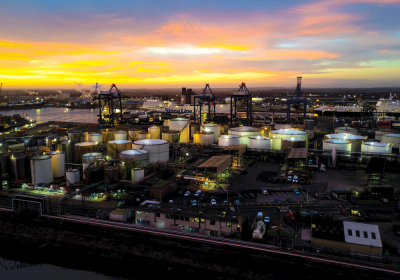
Exolum, Methanex Corporation and Ørsted announced the initiative at the Port of Immingham, the UK’s largest port by cargo volume and a key hub for energy and bulk materials. Exolum will provide storage and fuelling infrastructure, Methanex will supply the biomethanol and Ørsted will be the first customer, bunkering vessels that support its North Sea offshore wind farm maintenance operations.
These offshore support vessels are well suited to early adoption: their frequent port calls and predictable operating patterns make bunkering availability the critical constraint rather than tank range. The arrangement represents a fully integrated supply chain delivered through commercial partnership rather than public subsidy.
The launch comes amid ongoing uncertainty at the IMO, which recently deferred its vote on implementing its Net Zero Framework, a package of measures – including a global fuel standard and carbon pricing mechanism – designed to put shipping on a trajectory to net zero by 2050. The deferral had prompted concern that decarbonisation momentum could stall without a clear international framework, though the partners said it had not diminished their own commitment to action.
The collaboration demonstrates how existing energy infrastructure can be repurposed for emerging alternative fuels, reducing the capital cost and complexity of transition for ports and ship operators alike. Domestic shipping accounts for 4.7% of the UK’s transport-related CO₂ emissions, more than buses, trains and domestic aviation combined, while international shipping contributes roughly 3% of global greenhouse gas emissions, a share expected to grow as other sectors decarbonise more rapidly.
 |
|---|
The ISCC-certified biomethanol is produced at Methanex’s Gulf Coast facilities from waste-derived feedstocks and reduces lifecycle greenhouse gas emissions by up to 80%, compared with conventional marine fuels. Biomethanol is liquid at ambient temperature and pressure, and is chemically identical to fossil methanol, meaning methanol-capable vessels require no modification to use it.
The fuel’s growing commercial availability has tangible design implications. Biomethanol’s lower energy density, compared with heavy fuel oil means larger tank volumes are needed for equivalent range, with direct consequences for hull form, internal arrangement, stability, and the trade-off against cargo capacity. An orderbook of methanol-ready newbuilds, spanning container ships, offshore support vessels and ferries, reflects increasing owner confidence.
Vessels involved on these projects must also comply with the IMO’s IGF Code, which governs tank location, double-wall piping, ventilation, gas detection and emergency shutdown systems. Retrofit work presents additional complexity, requiring structural modifications, upgraded fuel handling systems and reassessment of stability and freeboard, an area of growing demand as bunkering infrastructure such as Immingham’s comes online.
The UK’s Department for Transport has published a roadmap targeting a 30% reduction in shipping emissions by 2030, 80% by 2040, and zero emissions by 2050, with biomethanol increasingly regarded as one of the more viable near-term pathways, particularly where hydrogen and ammonia remain constrained by infrastructure and technology readiness.
Steven Clapperton, head of marine (Humber) at Associated British Ports, says: “This initiative marks a significant moment for the Port of Immingham and the wider maritime sector. By enabling biomethanol bunkering, we are taking practical steps toward decarbonising one of the hardest-to-abate industries.”
Stuart McCall, vice president, low-carbon global market development, at Methanex, says: “As the world’s largest producer and supplier of methanol, Methanex is committed to developing and supporting innovative solutions that accelerate the transition to low-carbon shipping.”
This article appeared in In depth, TNA Mar/Apr 2026
| Article Tags | |
| Article Tags | Alternative fuels |
| Naval Architect Edition | |
| Naval Architect Edition | |
| General | |
| Preview Text | Three energy companies and Associated British Ports have joined forces to establish the UK’s first commercially ready biomethanol storage and bunkering service for shipping. It marks a significant step in the sector’s transition to low-carbon fuels and signals growing industry confidence in alternative marine fuels as a practical, near-term solution.
Exolum, Methanex Corporation and Ørsted announced the initiative at the Port of Immingham, the UK’s largest port by cargo volume and a key hub for energy and bulk materials. Exolum will provide storage and fuelling infrastructure, Methanex will supply the biomethanol and Ørsted will be the first customer, bunkering vessels that support its |