The USV launch and recovery 'missing link'
Sealartec's radical ALR-S technology can convert a conventional ship's stern ramp to a fully autonomous recovery system for unmanned surface vessels
Take 10 seconds to nominate a colleague, mentee or friend for our Forbes-style list. Must be under the age of 40 in 2026. Open to all maritime professions associated with naval architecture. See eligibility criteria. [hyperlinked].
Renowned for the technical excellence of our events, publications and learning, we offer career pathways for naval architects and 16 associated professions [hyperlink to 16 professions].
We cover everything from super yachts and green propulsion to warship resilience. Network 1-2-1 with top talent at our events or influence the maritime industry by joining one of our comittees.
We promote the interdisciplinary conversation at the heart of maritime innovation. Speak at our events, publish in our journals or simply join the discussion forums on our website.
?? HOW?? FILL IN EMAIL HERE AND SIGN UP WITH 1 CLICK
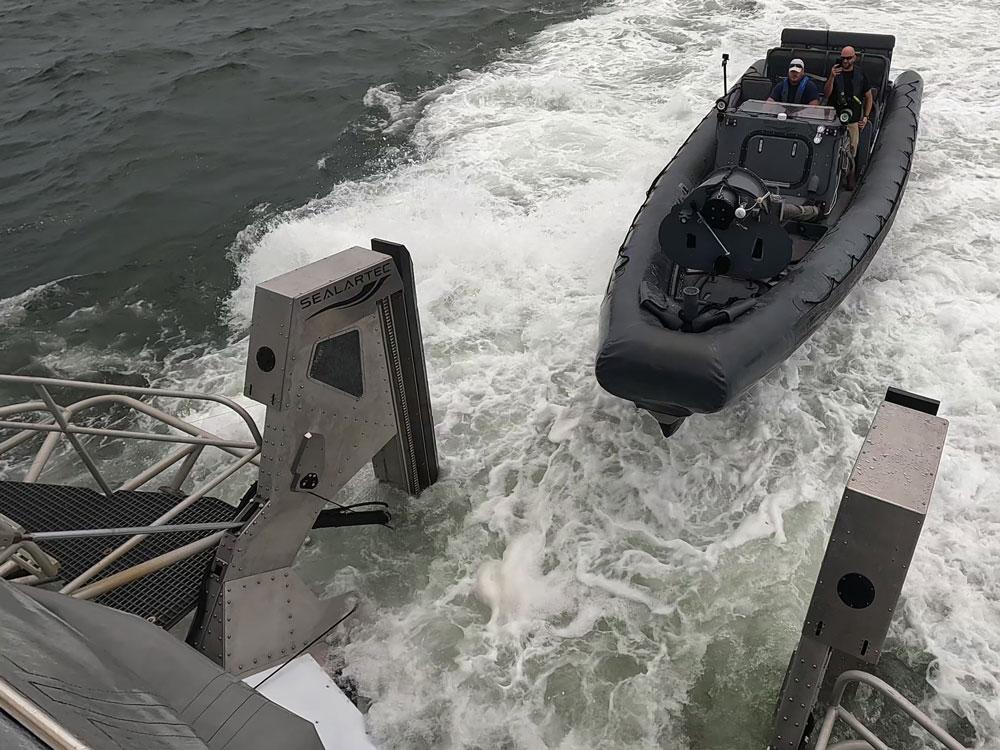
Sealartec's radical ALR-S technology can convert a conventional ship's stern ramp to a fully autonomous recovery system for unmanned surface vessels
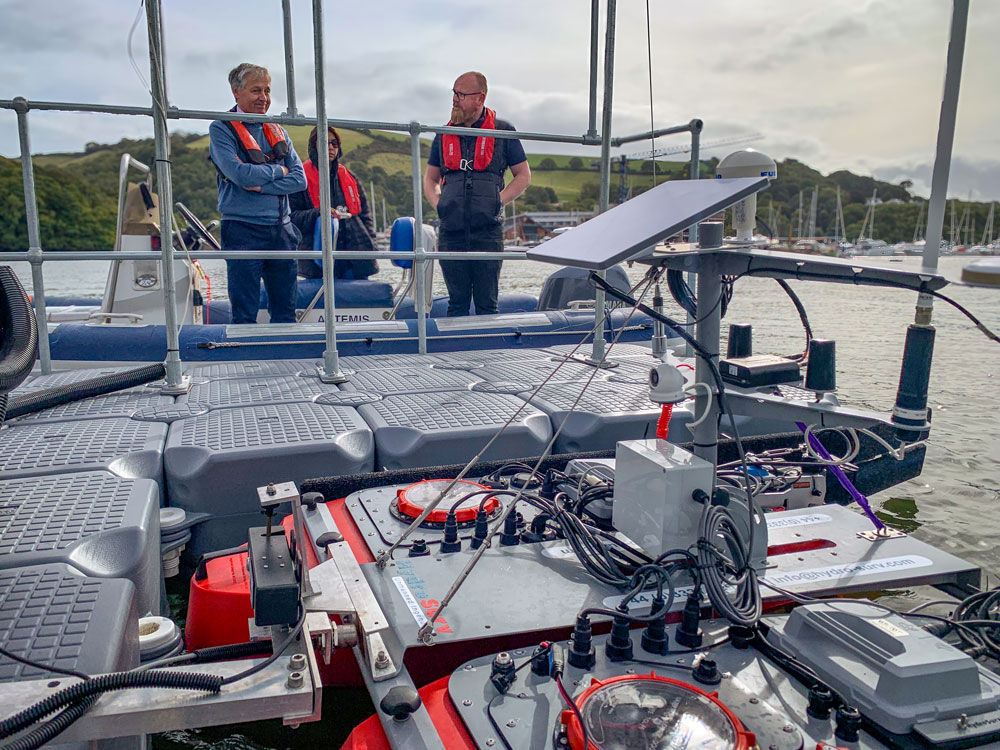
The UK-based ROC + DOCK project has brought together remote-controlled operations, a dual-function simulator and a ‘hands-off’ docking station, to encourage force multiplication of uncrewed vessels in ports and harbours
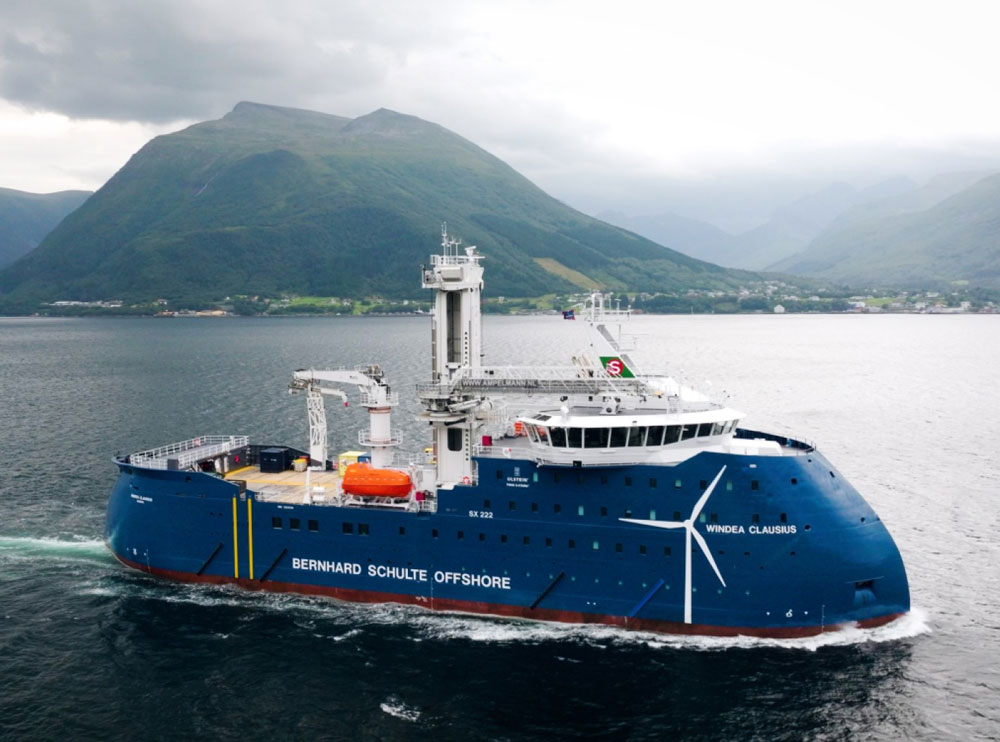
The latest addition to Bernhard Schulte Offshore’s CSOV fleet, Windea Clausius, combines a methanol-ready hybrid propulsion plant with Ulstein’s Twin X-STERN design for energy efficiency and ease of operations
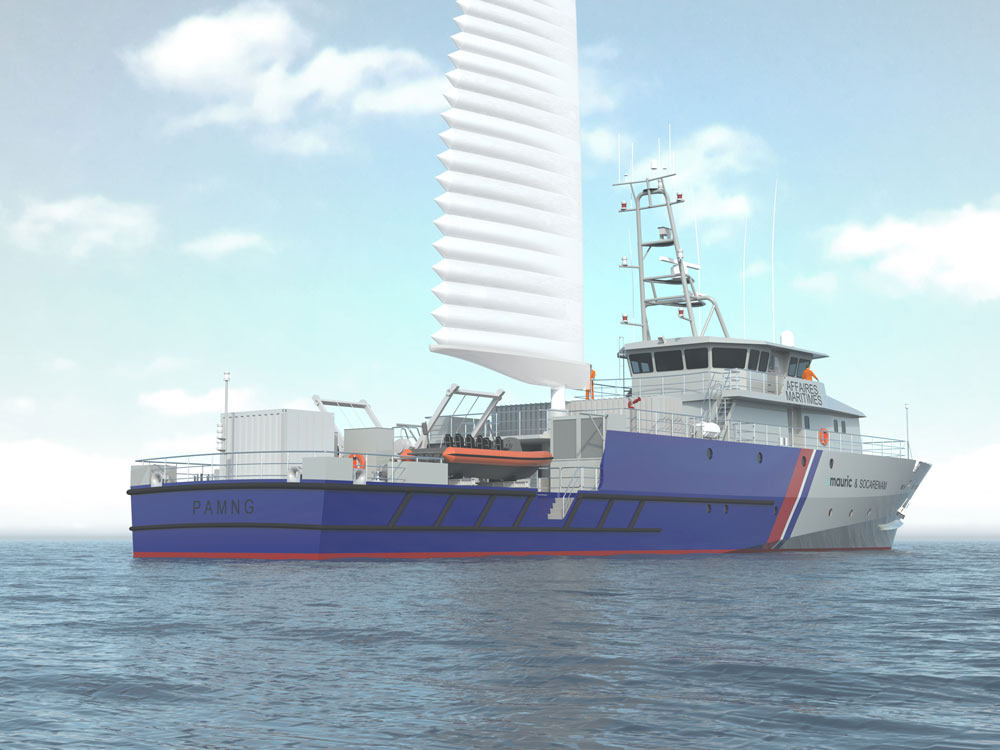
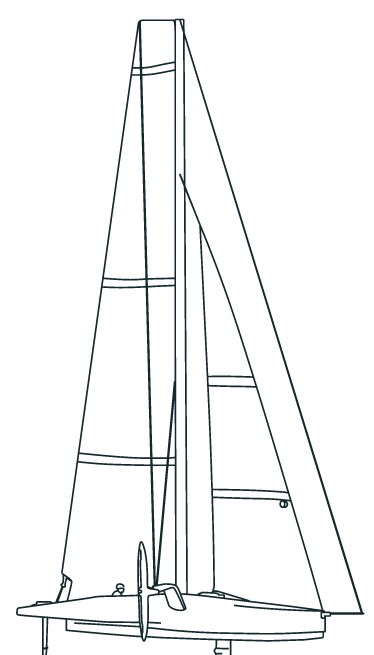
We've seen wingsails applied to bulkers and tankers - but aboard a smaller patrol boat? The latest design from MAURIC, set for launch in 2027, could open up an entirely new market for wind-assisted propulsion systems
From flagship international conferences to specialist technical seminars, RINA events bring together experts, innovators, and professionals to share knowledge and shape the future of naval architecture.
Explore Upcoming Events
Lorem ipsum dolor sit amet, consectetur adipiscing elit, sed do eiusmod tempor incididunt ut labore et dolore magna aliqua.
CLICK HERE
Lorem ipsum dolor sit amet, consectetur adipiscing elit, sed do eiusmod tempor incididunt ut labore et dolore magna aliqua.
CLICK HERE







Lorem ipsum dolor sit amet, consectetur adipiscing elit, sed do eiusmod tempor incididunt ut labore et dolore magna aliqua. Ut enim ad minim veniam, quis nostrud exercitation ullamco laboris nisi ut aliquip ex ea commodo consequat. Duis aute irure dolor in reprehenderit in voluptate velit esse cillum dolore eu fugiat nulla pariatur. Excepteur sint occaecat cupidatat non proident, sunt in culpa qui officia deserunt mollit anim id est laborum.

Military and paramilitary vessels have long used stern-based launch and recovery systems for manned vessels, but how do you launch and recover a USV, and enable multiple USVs deployed in ‘swarms’ to operate truly independently of manned vessels?
These are some of the challenges Israel-based Sealartec and its founder Amitai Peleg set out to solve, as he tells The Naval Architect. Peleg and Sealartec business development director Dov Raz describe launch and recovery as the ‘missing piece’ in USV technology development, one that USV designers and builders – and manufacturers of recovery systems, such as stern ramps and davits – have failed to address.
Whilst working for a well-known company that designed and built high-end USVs, Peleg recognised that no-one was addressing launch and recovery. He began working on an autonomous solution, subsequently raising funds for an incubator programme. The launch and recovery concept he developed has now reached the point where Sealartec is collaborating with the US Navy, Israeli Navy and BAE Systems, Huntington Ingalls Industries, IAI and MARTAC among others, and its technology has been successfully tested in the US and elsewhere, most recently in June 2025 by the Naval Surface Warfare Center, using the Stiletto, a vessel that serves as a modular testbed for emerging technology.
“Without safe, reliable launch and recovery systems that can handle USVs in adverse conditions, use of USVs is going to be severely constrained,” says Peleg. Raz adds: “We knew there was a need for a system that would remove human operators from the process, that was fully autonomous. A conventional stern ramp used to launch and recover manned rigid-hull inflatable boats is heavily dependent on a human operator’s skill and is a risky, challenging process, but when used for USVs, their design limits quickly become a critical obstacle.”
Raz continues: “Dependence on direct hull-to-ramp contact exposes manned craft to relative motion effects, impact loads and control difficulties, especially in moderate to high sea states. When a large host vessel and a small craft interact in waves, their heave and pitch motions are out of phase. Fleets using conventional or extended stern ramps report increasing risk to boat and ship beyond sea state 3. At that point, the difference in vertical displacement between the mothership’s stern and the daughter craft’s bow often exceeds 2m, with relative pitch angles of over 10°. The result is an unpredictable recovery window and an increased likelihood of impact or loss of control.
“As vessel size increases, this phase mismatch worsens. Larger ship hulls have longer natural pitch periods, which means their stern moves differently than a smaller USV. In such cases, extending the ramp’s length or depth provides little improvement, and relative motion, not geometry, becomes the limiting factor.”
When recovering unmanned units, the consequences of these constraints become potentially serious, not least because of the impact forces from a USV on the hull of a mothership. Without any form of motion compensation, they say, a 10,000kg USV re-entering a launch platform at 5-10knots can generate vertical relative motion of over 2m/s, releasing enormous impact energy, sufficient to cause structural damage and damage sensors and electronics.
For the full story, check out the November/December 2025 issue of The Naval Architect
A UK-based collaboration between USV developer HydroSurv, naval architect and designer BMT and South Devon College is nearing completion of a project set up to assess the benefits of electric USV operations in ports and harbours.
The ‘ROC + DOCK’ initiative has involved shoreside pilots remotely controlling South Devon College’s unmanned training vessel USV Dart – a 1.58m-long HydroSurv REAV-16 model, deployed on the River Dart—from a remote operations centre (ROC) on college grounds. Additionally, the partners have been trialling a remotely monitored, solar panel-equipped docking station, developed to recharge the USV with pure renewable energy – and all without manual intervention.
Funded through the Innovate UK Marine & Maritime Launchpad, the project aims to enable “true force multiplication of resident USVs operating across geographically separated coastal sites” while demonstrating “an integrated, end-to-end workflow that could transform how short-range environmental monitoring, inspection and surveillance missions are planned and executed – all from a centralised facility”, HydroSurv says.
ROC + DOCK commenced in early September, when the prototype docking station was deployed on the river. This station, designed internally by HydroSurv, is fitted with an automated mooring latch and has been designed to enable fully hands-off recovery of the USV, and recharging of its lithium-ion batteries. HydroSurv tells The Naval Architect: “The docking station’s power system is capable of charging [our] latest [2.5m-long] REAV-25 USV at up to 50A, to enable rapid replenishment. However, in practice, the USV will be recharged over longer periods when the vessel remains in the docking station for a few days at a time.”
At present, the docking station is designed for single-vessel support. HydroSurv adds: “The docking station control software is accessible to the vessel operator, providing the latching and unlatching system, monitored through a proximity sensor system. Charging is enabled through a contact charging system.”
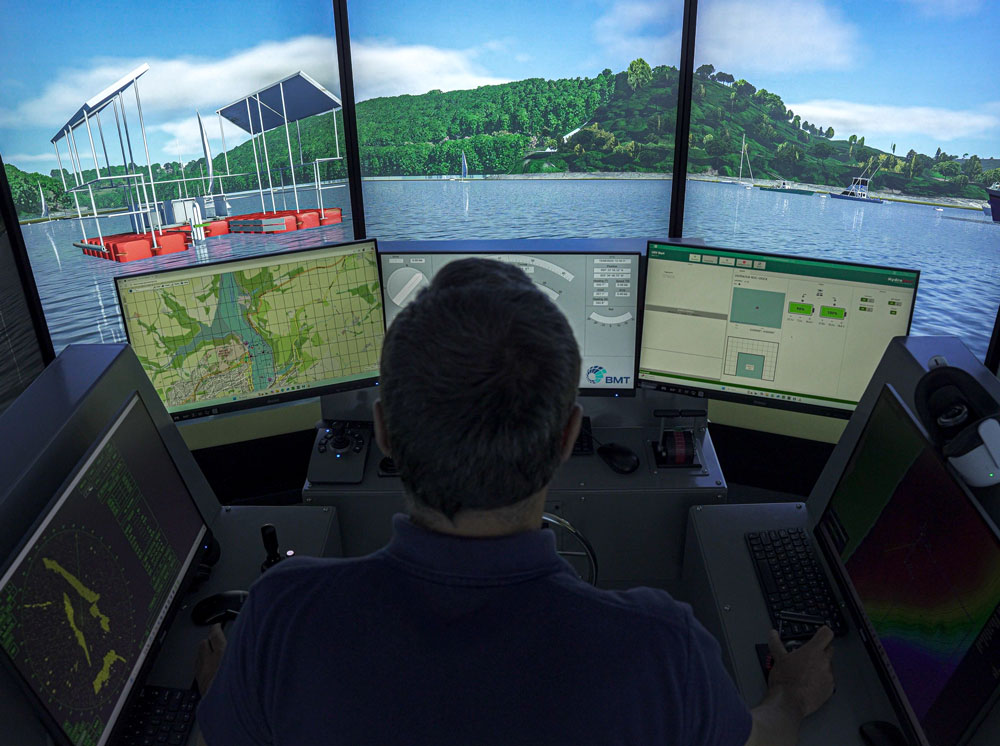
BMT’s Rembrandt simulator was integrated with HydroSurv’s vessel control software, enabling remote operator training and direct control of ‘USV Dart’
Back at the ROC, pilots remotely launched and navigated USV Dart by integrating HydroSurv’s vessel control software with BMT’s Rembrandt simulator – the latter tool more traditionally used for crewed vessel training. HydroSurv elaborates: “This capability – enabling operator training in a virtual environment that precisely replicates the vessel’s handling characteristics, before transitioning to live control – represents a significant advance in ROC design. It supports both the modernisation of maritime training syllabuses and the technical evolution of uncrewed operations facilities, with enhanced human factors and situational awareness at their core.
“Being a conventional vessel simulator, the spread is relational to the layout of a commercial vessel or workboat bridge, as opposed to more conventional screen layouts seen with remotely operated uncrewed vessel spreads.”
The River Dart trials have so far included water quality assessment missions involving pre-planned routes of up to 10km in line length from the docking station. These runs were based on standardised tasks from HydroSurv’s parallel ‘Smart Waters, Clean Ports’ project, launched last year, in which REAV-16 USVs transited rivers and estuaries around the ports of Dartmouth, Falmouth and Plymouth to assess local water pollution levels.
Summing up the USV Dart trials so far, HydroSurv states: “A two-person team can now execute multiple missions from a single facility, across dispersed coastal sites, without the need for local on-water support.” HydroSurv is now looking to further develop the integration between the USV and the Rembrandt simulator. This will likely include “enhancing the live view capabilities from an improved situational awareness spread, possibly with larger seagoing systems; and [evaluating] human factors for one-to-many USV supervision approaches”, the group says.
The docking station, meanwhile, will be honed to handle HydroSurv’s larger, seagoing USVs, “as part of an onward development roadmap”, HydroSurv adds. In November, as the project enters its final phase, the group aims to identify potential savings in terms of reduced crewing/support vessel costs and emissions through using the ROC, USV and docking station, compared with typical manned vessel set-ups.
Ulstein Verft has delivered Windea Clausius, the second in Bernhard Schulte Offshore’s new series of commissioning service operation vessels (CSOVs), writes Patrik Wheater. Windea Clausius and her sister Windea Curie, delivered in June, form part of an extensive newbuild programme that began in 2023. Hulls three and four are on schedule for delivery next year and will also enter service under the Windea Offshore joint venture, established to provide integrated logistics and operations support to wind farm developers in the North Sea and Baltic.
Built to Ulstein’s SX222 platform, unveiled in early 2021, the 2,200dwt Windea Clausius combines a methanol-ready hybrid diesel-electric propulsion plant with Ulstein’s hallmark TWIN X-STERN design, which allows the vessel to operate either bow- or stern-first. Ulstein says the novel hullform improves operability, lowers energy use and enhances comfort by reducing slamming and spray loads when holding position. The TWIN X-STERN – which evolved from Ulstein’s earlier X-STERN family introduced in 2015, and leverages on the success of its X-BOW design from 2004 – is awash with hydrodynamic refinements that include optimised propeller inflow to reduce underwater noise and vibration.
Speaking in 2021, Kolbjørn Moldskred, sales manager at Ulstein Design & Solutions, said: “It’s a completely different experience to be on board. It’s built to operate in strong currents and is less limited by weather conditions. TWIN X-STERN is in the same family as our other two revolutionary hulls, X-BOW and X-STERN, and provides similar benefits, just in a different set-up optimised for the offshore wind segment.”
With an overall length of 89.6m, a 19.2m beam and a draught of 5.9m, Windea Clausius’ hull was built at the Crist Shipyard before being towed to Ulstein Verft in Norway for the final phase, which included outfitting, paint work, electrical installation, equipment integration, commissioning and sea trial. The vessel is built for a service speed of about 10knots with propulsion provided by a Kongsberg Maritime package that integrates two main US 205 azimuth propellers fore and aft with a K-Power DC Hybrid solution, K-Chief EMS/IAS and K-Line control systems for smart energy management, fuel efficiency and optimal performance in dynamic positioning (DP) operations.
Electrical power to these and other consumers is through a hybrid battery-propulsion system, supplied by Everllence, which features a trio of methanol-ready MAN 175D-MEV (variable-speed) gensets, each rated 2.2MW and equipped with an integrated MAN closed-loop selective catalytic reduction (SCR) system to optimise emissions abatement. Indeed, Matthias Müller, Bernhard Schulte Offshore MD, said the engine design “is notable for its flexible use of various fuel grades, including biofuel, and its suitability for dual-fuel methanol retrofits”.
First-in-class Windea Curie represented the first reference for the engine which, when running on methanol, can cut CO2 emissions by up to 95%, NOx by up to 80%, and SOx and particulate matter completely. Complying with IMO Tier III NOₓ-emission standards, the hybrid arrangement is also claimed to deliver up to 10% fuel savings in typical North Sea service and reduce generator operating hours, cutting maintenance costs.
Øyvind Gjerde Kamsvåg, chief designer at Ulstein, said in 2021: “The key advantage of the hull is its ability to stay in position. The secret lies below the waterline. TWIN X-STERN has main propeller units at each end, which provide maximum manoeuvrability. The hull also provides major fuel savings; we have findings from the sister patent X-STERN, which show a reduction in power consumption of up to 60% when manoeuvring stern-first compared to flat transom stern.”
Equipped with a large, height-adjustable, centrally located walk-to-work gangway and elevator tower for personnel and cargo transfers, the vessel includes a 3D motion-compensated crane for offshore lifts of up to 5tonnes. Onboard logistics are optimised with spacious storage areas and stepless access to offshore installations.
While the hull’s symmetry and twin-ended propulsion allow the ship to weather-vane naturally, maintaining heading with minimal thrust and energy demand, the bridge layout follows Ulstein’s Insight Bridge concept, combining navigation, DP, crane and gangway operations in an ergonomic, 360° workspace that improves situational awareness during complex offshore manoeuvres.
Until now, aside from some short-sea/coastal shipping applications, wind-assisted propulsion systems (WAPS) have tended to be the domain of 100m+, oceangoing vessels, including tankers and large cargo ships. So, it’s something of a surprise to see WAPS technology being applied to a patrol boat, as is the case with the New Generation Maritime Affairs Patrol Vessel (PAMNG) project, spearheaded by French naval architecture and marine engineering firm MAURIC.
Officially announced in January 2025, the PAMNG’s first steel was cut in September at Socarenam’s shipyard in Boulogne-Sur-Mer, France. The concept is for a 53.7m-long boat with a steel hull and an aluminium superstructure, powered by a diesel-electric hybrid system and a deck-mounted Wisamo wingsail, manufactured and supplied by Michelin, and featuring a surface area of 170m2.
Delivery to the owner, the French Directorate General for Maritime Affairs, Fisheries and Aquaculture (DGAMPA), is earmarked for the second half of 2027, and the vessel will operate primarily in the Bay of Biscay, undertaking missions including maritime fisheries surveillance, pollution monitoring, enforcing compliance with environmental regulations, search and rescue operations, anti-trafficking activities and protection of French national interests. The Bay’s challenging winds and waves should make it an ideal proving ground for wind-assisted propulsion tech in real-world enforcement scenarios.
Combined with the diesel-electric powertrain, the wingsail will help the PAMNG to achieve a maximum speed of 17knots at 85% MCR – reduced to 10knots when the vessel operates on electric alone – and overall fuel savings in the region of 15%. The PAMNG will also feature an endurance of 3,600nm at 12knots, MAURIC says.
The Wisamo includes a telescopic and retractable carbon-fibre mast, which can be lowered when the vessel enters port or passes under bridges. The wingsail is made of a light but strong fabric like a conventional boat’s sail, and fills with air at low pressure when the mast extends. A small fan blows in air to keep the wing’s shape smooth and even, while built-in sensors enable the wing to autonomously adjust its angle to capture the right amount of wind, providing more speed, saving fuel and reducing crew workload during long patrols. The PAMNG will also incorporate solar panels for auxiliary power, as well as an active trim control system to minimise energy consumption.
For this project, MAURIC conducted a detailed arrangement study for the vessel, including an ‘optimisation loop’ – an iterative computational process, used to simulate wind, speed, fuel use and stability to inform the best positioning for the sails for optimal performance. MAURIC says: “This phase also enabled the finalisation of active and passive stabilisation systems development, through seakeeping calculations carried out to optimise the anti-roll tank with free surface effects and active fin stabilisers.” Using CFD simulations, MAURIC then designed the boat’s bulbous bow to refine the hull’s hydrodynamic performance. “These CFD studies have optimised resistance through the water and defined the vessel’s active trim control system underway, confirming a hybrid cruising speed of 10knots and maximum speed exceeding 18knots,” the company says. “This configuration ensures the energy efficiency sought for this vessel with reduced environmental footprint.” Advanced modelling also predicted reduced drag in moderate seas.
The PAMNG has been arranged for a crew of 16 and four special forces personnel, and has an autonomy of 12 days – sufficient, MAURIC says, to guarantee sea patrols for up to 200 days annually. In addition to its crew complement, the vessel will carry a pair of 6.5m-long, semi-rigid boats, capable of 35knot intercepts.
MAURIC’s previous forays into wind-assisted propulsion include the 136m x 24.2m, sail-powered ro-ro cargo vessel Neoliner Origin, which was launched by RMK Marine’s shipbuilding facility in Turkey earlier this year, and which made its first transatlantic voyage in October.

Lorem ipsum dolor sit amet, consectetur adipiscing elit, sed do eiusmod tempor incididunt ut labore et dolore magna aliqua. Ut enim ad minim veniam, quis nostrud exercitation ullamco laboris nisi ut aliquip ex ea commodo consequat. Duis aute irure dolor in reprehenderit in voluptate velit esse cillum dolore eu fugiat nulla pariatur. Excepteur sint occaecat cupidatat non proident, sunt in culpa qui officia deserunt mollit anim id est laborum.
Lorem ipsum dolor sit amet, consectetur adipiscing elit, sed do eiusmod tempor incididunt ut labore et dolore magna aliqua. Ut enim ad minim veniam, quis nostrud exercitation ullamco laboris nisi ut aliquip ex ea commodo consequat. Duis aute irure dolor in reprehenderit in voluptate velit esse cillum dolore eu fugiat nulla pariatur. Excepteur sint occaecat cupidatat non proident, sunt in culpa qui officia deserunt mollit anim id est laborum.
Lorem ipsum dolor sit amet, consectetur adipiscing elit, sed do eiusmod tempor incididunt ut labore et dolore magna aliqua. Ut enim ad minim veniam, quis nostrud exercitation ullamco laboris nisi ut aliquip ex ea commodo consequat. Duis aute irure dolor in reprehenderit in voluptate velit esse cillum dolore eu fugiat nulla pariatur. Excepteur sint occaecat cupidatat non proident, sunt in culpa qui officia deserunt mollit anim id est laborum.
Lorem ipsum dolor sit amet, consectetur adipiscing elit, sed do eiusmod tempor incididunt ut labore et dolore magna aliqua. Ut enim ad minim veniam, quis nostrud exercitation ullamco laboris nisi ut aliquip ex ea commodo consequat. Duis aute irure dolor in reprehenderit in voluptate velit esse cillum dolore eu fugiat nulla pariatur. Excepteur sint occaecat cupidatat non proident, sunt in culpa qui officia deserunt mollit anim id est laborum.
Lorem ipsum dolor sit amet, consectetur adipiscing elit, sed do eiusmod tempor incididunt ut labore et dolore magna aliqua. Ut enim ad minim veniam, quis nostrud exercitation ullamco laboris nisi ut aliquip ex ea commodo consequat. Duis aute irure dolor in reprehenderit in voluptate velit esse cillum dolore eu fugiat nulla pariatur. Excepteur sint occaecat cupidatat non proident, sunt in culpa qui officia deserunt mollit anim id est laborum.
Lorem ipsum dolor sit amet, consectetur adipiscing elit, sed do eiusmod tempor incididunt ut labore et dolore magna aliqua. Ut enim ad minim veniam, quis nostrud exercitation ullamco laboris nisi ut aliquip ex ea commodo consequat. Duis aute irure dolor in reprehenderit in voluptate velit esse cillum dolore eu fugiat nulla pariatur. Excepteur sint occaecat cupidatat non proident, sunt in culpa qui officia deserunt mollit anim id est laborum.
text one
Lorem ipsum dolor sit amet, consectetur adipiscing elit, sed do eiusmod tempor incididunt ut labore et dolore magna aliqua. Ut enim ad minim veniam, quis nostrud exercitation ullamco laboris nisi ut aliquip ex ea commodo consequat. Duis aute irure dolor in reprehenderit in voluptate velit esse cillum dolore eu fugiat nulla pariatur. Excepteur sint occaecat cupidatat non proident, sunt in culpa qui officia deserunt mollit anim id est laborum.
A UK-based collaboration between USV developer HydroSurv, naval architect and designer BMT and South Devon College is nearing completion of a project set up to assess the benefits of electric USV operations in ports and harbours.
The ‘ROC + DOCK’ initiative has involved shoreside pilots remotely controlling South Devon College’s unmanned training vessel USV Dart – a 1.58m-long HydroSurv REAV-16 model, deployed on the River Dart—from a remote operations centre (ROC) on college grounds. Additionally, the partners have been trialling a remotely monitored, solar panel-equipped docking station, developed to recharge the USV with pure renewable energy – and all without manual intervention.
Funded through the Innovate UK Marine & Maritime Launchpad, the project aims to enable “true force multiplication of resident USVs operating across geographically separated coastal sites” while demonstrating “an integrated, end-to-end workflow that could transform how short-range environmental monitoring, inspection and surveillance missions are planned and executed – all from a centralised facility”, HydroSurv says.
ROC + DOCK commenced in early September, when the prototype docking station was deployed on the river. This station, designed internally by HydroSurv, is fitted with an automated mooring latch and has been designed to enable fully hands-off recovery of the USV, and recharging of its lithium-ion batteries. HydroSurv tells The Naval Architect: “The docking station’s power system is capable of charging [our] latest [2.5m-long] REAV-25 USV at up to 50A, to enable rapid replenishment. However, in practice, the USV will be recharged over longer periods when the vessel remains in the docking station for a few days at a time.”
At present, the docking station is designed for single-vessel support. HydroSurv adds: “The docking station control software is accessible to the vessel operator, providing the latching and unlatching system, monitored through a proximity sensor system. Charging is enabled through a contact charging system.”
BMT’s Rembrandt simulator was integrated with HydroSurv’s vessel control software, enabling remote operator training and direct control of ‘USV Dart’
Back at the ROC, pilots remotely launched and navigated USV Dart by integrating HydroSurv’s vessel control software with BMT’s Rembrandt simulator – the latter tool more traditionally used for crewed vessel training. HydroSurv elaborates: “This capability – enabling operator training in a virtual environment that precisely replicates the vessel’s handling characteristics, before transitioning to live control – represents a significant advance in ROC design. It supports both the modernisation of maritime training syllabuses and the technical evolution of uncrewed operations facilities, with enhanced human factors and situational awareness at their core.
“Being a conventional vessel simulator, the spread is relational to the layout of a commercial vessel or workboat bridge, as opposed to more conventional screen layouts seen with remotely operated uncrewed vessel spreads.”
The River Dart trials have so far included water quality assessment missions involving pre-planned routes of up to 10km in line length from the docking station. These runs were based on standardised tasks from HydroSurv’s parallel ‘Smart Waters, Clean Ports’ project, launched last year, in which REAV-16 USVs transited rivers and estuaries around the ports of Dartmouth, Falmouth and Plymouth to assess local water pollution levels.
Summing up the USV Dart trials so far, HydroSurv states: “A two-person team can now execute multiple missions from a single facility, across dispersed coastal sites, without the need for local on-water support.” HydroSurv is now looking to further develop the integration between the USV and the Rembrandt simulator. This will likely include “enhancing the live view capabilities from an improved situational awareness spread, possibly with larger seagoing systems; and [evaluating] human factors for one-to-many USV supervision approaches”, the group says.
The docking station, meanwhile, will be honed to handle HydroSurv’s larger, seagoing USVs, “as part of an onward development roadmap”, HydroSurv adds. In November, as the project enters its final phase, the group aims to identify potential savings in terms of reduced crewing/support vessel costs and emissions through using the ROC, USV and docking station, compared with typical manned vessel set-ups.
Nominate a colleague, a mentee or a friend for one of our prestiguous Naval Architecture Awards. Chosen by our Committees, the winners will be announced at our Annual Dinner attended by more than 300 maritime professionals, industry leaders and academics. Taking place on 28th May, this will be an evening of celebration at the historic De Vere Grand Connaught Rooms in London.
Nominations deadline: on 31st December. Award categories include Innovation, Safety and Diversity.