

Hanwha Ocean signs landmark agreements with Canada
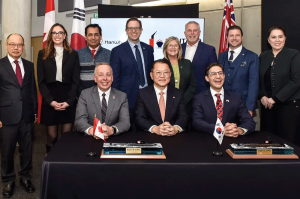
Hanwha Ocean is embedding its shipbuilding expertise directly into Canadian industry. The South Korean shipbuilder has signed a Memorandum of Understanding (MoU) with Ontario Shipyards and a trilateral Letter of Intent (LoI) with Ontario Shipyards and Mohawk College, establishing a technology transfer, industrial modernisation and workforce development framework in the Great Lakes region. The move is part of an effort to position itself for the Canadian Patrol Submarine Project (CPSP), one of the most consequential naval procurement decisions in Canadian history.
The CPSP aims to replace the Royal Canadian Navy’s ageing Victoria-class submarines with up to 12 modern vessels. Hanwha’s proposed platform is the KSS-III, a conventionally powered submarine designed for long-range operations and sustained presence at sea, including in Arctic environments, with a mature, production-ready design and lithium-ion propulsion.
The lithium-ion battery system offers significantly higher energy density than traditional lead-acid batteries. Combined with a fuel cell-based Air Independent Propulsion system, this advanced configuration enables the submarine to remain submerged for extended periods and sustain maximum underwater speed up to three times longer than submarines using lead-acid batteries. This system has enabled the KSS-III to set a world record for the longest continuous underwater operation by a conventional submarine. In addition, lithium-ion batteries provide longer life cycles and simplified maintenance, lowering both operational and sustainment costs.
Hanwha Ocean claims the programme would generate 200,000 job-years over 15 years and support approximately 15,000 jobs per year on average across a pan-Canadian industrial alliance of more than 100 companies.
 |
 |
|---|
The bilateral MoU commits Hanwha Ocean to structured technical and operational support across design and engineering, production planning, construction sequencing, quality management and smart-yard best practices. A near-term proof-of-concept is built into the agreement: Hanwha Ocean will support the design and construction of a training and recruitment vessel that Ontario Shipyards will begin building in 2026, providing a live demonstration of the partnership’s industrial intent rather than relying on declarations alone.
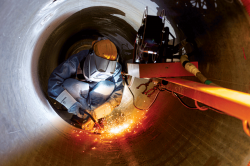
Workforce development will be addressed through the trilateral LOI, which establishes an embedded training hub at Ontario Shipyards’ Hamilton facility in partnership with Mohawk College. The college will lead programming across welding, electrical trades, marine mechanics, robotics and non-destructive evaluation. It is a curriculum mapped directly onto the skilled trades shortfall that has constrained Canadian shipbuilding for years.
Apprenticeship pathways will be integrated with production schedules, with applied research in automation and digital manufacturing on the agenda too. Hanwha Ocean will contribute technical advisory support and access to its global industrial networks to align training with international standards.
Both documents contain conditional language tying further Hanwha investment, including a dedicated training centre and expanded supply chain engagement, to the award of the CPSP contract.
 |
|---|
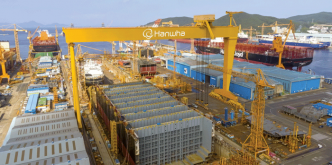
Hanwha has been active across Canada, with Quebec’s minister of international relations, Christopher Skeete, visiting the Geoje shipyard in February, and Canadian yard leaders separately touring the facility to discuss collaboration and MRO opportunities. Hanwha’s Geoje shipyard covers 5km2, employs more than 31,000 people and has delivered more than 1,400 vessels since 1973, including submarines and surface combatants for the Republic of Korea Navy.
Ontario Shipyards, the largest ship repair and construction company on the Great Lakes, now has facilities at Hamilton, Port Weller and Thunder Bay.
The combination of Hanwha’s production systems and Ontario’s existing infrastructure represents a credible industrial base, although execution of the knowledge transfer at the pace and depth the CPSP would require remains the programme’s defining test.
This article appeared in In depth, TNA Mar/Apr 2026
| Naval Architect Edition | |
| Naval Architect Edition | |
| General | |
| Preview Text | Hanwha Ocean is embedding its shipbuilding expertise directly into Canadian industry. The South Korean shipbuilder has signed a Memorandum of Understanding (MoU) with Ontario Shipyards and a trilateral Letter of Intent (LoI) with Ontario Shipyards and Mohawk College, establishing a technology transfer, industrial modernisation and workforce development framework in the Great Lakes region. The move is part of an effort to position itself for the Canadian Patrol Submarine Project (CPSP), one of the most consequential naval procurement decisions in Canadian history.
The CPSP aims to replace the Royal Canadian Navy’s ageing Victoria-class submarines with up to 12 |
| Article Tags | |
| Article Tags | SubmarinesLaunch and delivery |