

Flying boats rewrite the rules of fast craft design
As pressure mounts to decarbonise high-speed maritime transport, hydrofoiling technology is emerging as a disruptive force in vessel design.
Stockholm-based Candela Technology is at the forefront of this shift, leveraging electric propulsion and advanced hydrofoil systems to dramatically cut energy consumption, extend range and redefine performance benchmarks.
This all challenges long-held assumptions about the efficiency, economics and operational limits of fast ferries.
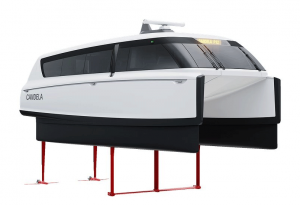
Candela's watercraft have wings (hydrofoils) that lift the hull above the water and reduce friction, using 80% less energy than conventional ships at high speed. This technology allows for longer-range travel using solely battery power.
The company says that these hydrofoils enable operators to transition to more designer sustainable fleets by providing up to 50% lower operational costs.
At the heart of Candela's hydrofoil tech stack is the Flight controller, which automatically stabilises the vessel during flight by regulating the foils, using sensors that gauge wave height and wind speed, among other factors.
Even in rough weather, passengers experience 90% less G-force than they would on a traditional boat.
Candela produced what it claimed was the world's first electric hydrofoil leisure boat in 2019, the Candela C-7 open "roadster of the seas". This was followed in 2022 by the high-volume market Candela C-8, which was delivered to its first customers in spring 2023. The C-8 won the 2022 European Powerboat of the Year award for its superior seakeeping, long range and high speed.
In 2023, the company launched its first commercial vessel, the Candela P-12 Shuttle ferry. It claims to be the fastest and longest-range electric ship ever built, with a top speed of 30knots and a range of 40nm at 25knots.
The first unit entered into service in Stockholm's public transport system in 2024. So far, more than 30 units have been sold to Saudi Arabia, Maldives, India, USA and other markets.
Hydrofoil benefits
Over the years, Candela’s hydrofoil-assisted system has worked to fundamentally change energy–speed scaling assumptions for fast ferry design and fast craft.
“Conventional fast ferries see power demand rise steeply with speed because wave-making resistance increases rapidly. Hydrofoils lift the hull clear of the water, largely eliminating wave drag and reducing wetted surface a lot,” says Mikael Mahlberg, head of PR & communications at Candela.
“Resistance is then dominated by foil drag rather than hull drag, allowing much higher speeds for the same energy input. In practice, we are making electric ferries with around 80% less energy usage at high speeds than conventional ferries of the same size.”
Structural and weight-distribution challenges arise when combining battery propulsion with foil-supported hullforms. Batteries add significant mass, so strict weight control and precise centre-of-gravity placement are essential, says Mahlberg.
 |
|---|
Extra weight increases foil loading and drag, directly affecting efficiency. Foils also introduce concentrated cyclic loads at their attachment points, requiring lightweight but very stiff structures with careful fatigue design while safely integrating the battery system.
In the DNV-approved Candela P-12, the batteries are placed in the front of the boat, accounting for passenger weight in the aft section of the vessel.
Re-shaping route planning
Mahlberg explains that hydrofoil efficiency reduces dependence on fixed megawatt-scale charging infrastructure and therefore works to reshape route planning assumptions.
Hydrofoils dramatically reduce energy consumption compared with conventional fast ferries, so charging requirements are much lower.
This means vessels can use standard high-power auto DC chargers rather than megawatt-scale systems, making route deployment possible even where grid infrastructure is limited.
The difference is apparent in Oslo, Mahlberg says, where electric 180-pax ferries use robotic arms that swap battery packs over in vessels costing millions of euros and taking years to build.
Candela’s P-12 in Stockholm by comparison charges from a mobile battery charger, which was deployed in just two days.
In addition, Mahlberg says that reduced wave impact and hull efficiency resulting from hydrofoils will help to influence future fast craft hullform optimisation.
Hydrofoils generate far less wake and significantly reduce vertical accelerations, improving comfort and lowering shoreline impact.
Mahlberg says the P-12’s hull is a catamaran hull, designed for efficient speeds up to 10knots.
“Traditional vessels need to be designed with hulls that are compromised between slow and high speed – ours doesn’t need to be a compromise, because when the vessel is foiling, the hull is out of the water entirely,” he says.
 |
|---|
Record-breaking journey
Electric ferries are gaining momentum globally. However, high energy consumption and limited range have so far restricted most electric vessels to short, predefined routes, even in Norway, where more than 100 operate.
But Candela is on a mission to change this. Its flagship build, the Candela P-12 has recently completed the world’s longest electric sea journey in a record-breaking 160nm voyage from Sweden’s west coast to Norway’s capital, Oslo.
Already proven in Stockholm’s public transport system, Candela P-12 holds the record as the fastest electric passenger vessel in operation, with a service speed of 25knots and a range of up to 40nm at cruise speed on a single charge.
The mission was to reach Oslo, where several electric high-speed ferries are already in service.
Oslo’s fastest electric passenger ferry, m/s Baronen, operates a fixed 10nm route and relies on swapping a deck-mounted battery container with several megawatt-hours of capacity at the end of each trip. The automated battery-swapping system alone costs hundreds of millions of Norwegian kroner. While several swap stations have faced delays and cost overruns, limiting route flexibility.
By contrast, Mahlberg says, Candela P-12’s efficiency allows it to charge from standard, easily deployable automotive DC fast chargers.
During the journey, the Candela crew charged along Sweden’s existing DC fast-charging network using Aqua SuperPower stations. Where fixed chargers were unavailable, they relied on a towable battery system provided by Skagerak Energi.
The 160nm journey was completed over three days with the total electricity cost amounting to just over €200.
| Naval Architect Edition | |
| Naval Architect Edition | |
| Article Tags | |
| Article Tags | |
| General | |
| Article Preview Text | As pressure mounts to decarbonise high-speed maritime transport, hydrofoiling technology is emerging as a disruptive force in vessel design. Stockholm-based Candela Technology is at the forefront of this shift, leveraging electric propulsion and advanced hydrofoil systems to dramatically cut energy consumption, extend range and redefine performance benchmarks. This all challenges long-held assumptions about the efficiency, economics and operational limits of fast ferries. |