

Tailor-making the approach to fast ferries
Global decarbonisation targets are fundamentally reshaping the design philosophy of high-speed vessels, placing energy efficiency and lifecycle performance at the centre of naval architecture.
For aluminium fast ferry specialist Strategic Marine, this shift is driving a more integrated approach to vessel development, where hullform optimisation, propulsion systems and structural design must work in tandem to meet tightening emissions requirements while maintaining speed, payload and commercial viability.
Hans Randklev, general manager, commercial, Strategic Marine, tells RINA that low-emission targets are helping reshaping hullform optimisation in large aluminium passenger catamarans.
“Low-emission targets including the IMO’s 2030 and 2050 goals have shifted hullform optimisation from being primarily speed-driven to being focused on overall energy efficiency,” he says.
“In the world of aluminium passenger catamarans, this means every millimetre of the hull is now being scrutinised to reduce resistance across a range of operating conditions while supporting the industry’s transition toward electrification and alternative fuels.”
The aim, he says, is to lower fuel consumption on a per-passenger basis rather than concentrating on peak speed alone.
Hull efficiency
At Strategic Marine, the design process also means considering how hull efficiency influences range, potential battery sizing and overall vessel economics as propulsion technologies evolve.
Randklev explains that there are some structural design challenges that emerge as passenger capacity increases within lightweight aluminium fast ferry designs.
This is because scaling up passenger capacity isn’t just about adding seats but also exponentially increasing the structural demands on a material that is prized for its significant weight advantages.
The demands on the vessel’s ability to withstand structural loads at sea, performance and long-term durability increases along with capacity. This creates a careful balancing act between structural robustness, payload and performance.
“At the same time, evolving propulsion technologies such as hybrid systems and alternative fuels may introduce additional weight and integration requirements, further increasing the complexity of the overall design,” he says.
Vessel decarbonisation
The importance of emissions reduction is changing how vessels are designed from the outset, says Randklev, it is not simply about factoring in a change in equipment now.
 |
|---|
For high-speed aluminium ferries where weight margins are tight and power demands are high, newer propulsion concepts – including hybrid configurations and alternative fuels – can affect weight distribution, space layout and onboard safety requirements.
These factors must be carefully balanced against payload, range and performance.
“This requires taking a more integrated design approach where hullform, propulsion and energy systems are considered together to ensure operational efficiency while supporting emissions reduction,” he says.
Perhaps the wider issue here is the more complex issue of how naval architects can future-proof fast ferries given ever evolving environmental regulation and the transition to alternative fuelled propulsion.
It’s a complex issue and one that Randklev says involves moving beyond traditional designs and embracing evolutionary engineering.
“As fast ferries have high power requirements and incredibly sensitive weight margins, the transition from fossil fuels to low- to zero-emission alternatives is more technically demanding than for slower cargo vessels,” he notes.
He adds that with ongoing uncertainty around fuel availability and the pace of regulatory change, vessels need to be designed to accommodate evolving propulsion systems over time.
This includes enabling upgrades without major structural modifications, as well as maintaining flexibility in machinery space and weight allocation.
“We approach this by building on efficient baseline designs and working closely with our clients and partners to ensure vessels remain adaptable as propulsion technologies evolve,” he says.
Bermuda ferries
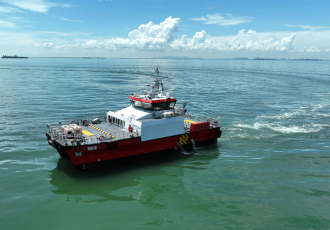
One of Strategic Marine’s most recent stand-out fast ferry contracts was the delivery of two 40m, 550-passenger low-emission catamaran ferries to the Government of Bermuda.
The vessels were a landmark delivery in the fast ferry sector for the region and the result of the culmination of a two-year intricate design and build process.
Designed by One2Three Naval Architects in Sydney, Australia, the custom designed and built Warbaby Fox and JL Cecil Smith ferries have a capacity for 550 passengers each with designated wheelchair spaces to meet accessibility needs.
Randklev explains that the major challenge from a design perspective was in accommodating this many passengers on what is a relatively small platform for this number of people while still maintaining vessel performance, operability, safety and aesthetics.
Importantly, the vessels produce 25% lower CO2 emissions when compared to the previous ferries that used to service the route on a passenger mile basis.
 |
|---|
This is due to their Z-bow hulls which benefit from One2three’s many years of hull design optimisation. Careful chine placement minimises water spray, ensuring a dry ride.
In choosing two larger engines instead of four smaller engines (dual Caterpillar 3512C engines with VEEM Star-C propellers), the demi-hull beams could also be reduced thereby reducing hull resistance.
The superstructure is a rafted design, joined to the hull through mounts which serve to isolate the hull from engine noise and vibration.
For the interior fit-out, Strategic Marine engaged the services of Spear Green Design for design while ICF was contracted for the build.
Fast ferry market
Randklev says there is a growing demand for these large, efficient catamarans on the market, but this doesn’t necessarily signal consolidation toward higher-capacity fast ferry platforms globally.
He notes that the demand for large catamarans is apparent on high-volume routes where operators are looking to move more passengers per voyage while reducing emissions on a per-passenger basis.
However, the global fast ferry market remains diverse, with continued demand for mid-sized and specialised vessels across different operating environments such as port limitations, route distances or operational constraints.
“Rather than full consolidation, the market continues to move toward more tailored vessel designs, reflecting differences in operating environments, route profiles and regional requirements,” he explains.
And for each project, he says, it’s key that an individual approach be taken towards each vessel’s own operational requirements.
| Article Tags | |
| Article Tags | |
| General | |
| Article Preview Text | Global decarbonisation targets are fundamentally reshaping the design philosophy of high-speed vessels, placing energy efficiency and lifecycle performance at the centre of naval architecture. For aluminium fast ferry specialist Strategic Marine, this shift is driving a more integrated approach to vessel development, where hullform optimisation, propulsion systems and structural design must work in tandem to meet tightening emissions requirements while maintaining speed, payload and commercial viability. Hans Randklev, general manager, commercial, Strategic Marine, tells RINA that low-emission targets are |
| Naval Architect Edition | |
| Naval Architect Edition | |