

Autonomy as a capability multiplier
AI system developer, MarineAI has formed a close partnership with the uncrewed surface vessel designer and builder, ZeroUSV, reflecting a growing concentration of operational maritime autonomy capability across the defence sector.
Together, they have created a first-of-its-kind programme to create a distributed sensing network that supports underwater monitoring and secure communications for submersible fleet operations.
Funded by UK Defence Innovation (UKDI), the initiative will deploy autonomous vessel platforms and acoustic systems to maintain covert contact with underwater assets without relying on high-bandwidth or detectable links, enabling more resilient subsea mapping, intelligence and infrastructure monitoring.
Simplifying decision-making
Central to the MarineAI ethos is the view that the introduction of onboard decision-support systems should not make the bridge more complicated.
Modern warships already manage large volumes of information from navigation systems, sensors and mission equipment. Simply adding further displays or alert systems increases operator workload and does little to promote efficient or accurate decision making.
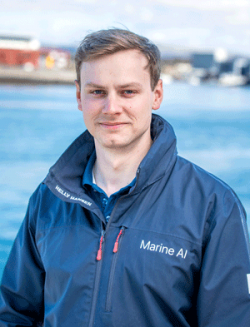
“The opportunity with autonomous systems is to simplify the decision-making pathway. Autonomy software can process large volumes of onboard data and distilling it into clear, actionable information,” says Oliver Thompson, director of engineering at MarineAI.
“This can then be presented to operators as recommendations, or, in specific trusted cases such as navigational routing, can be executed by the system itself.”
One of the key requirements of autonomous capability is decision transparency, he says.
 |
|---|
Operators must be able to understand how a recommendation has been reached and what informed a decision and that builds trust in the system.
For this reason, autonomous capability should be accessible to operators through existing bridge and command interfaces rather than appearing as a separate and isolated console on an additional screen.
Reliability, fidelity and availability
So, what platform design requirements can emerge from deploying autonomy systems in operational naval environments?
From a platform perspective, the requirements are broadly consistent with those for other critical naval systems. Reliability, fidelity and availability are fundamental, Thompson says.
Autonomous capability must remain functional during operations if it is to be trusted in theatre.
The overall system must also account for hardware faults and routine maintenance cycles. Redundancy and failover therefore need to be built into the onboard computing architecture in the same way they are for navigation, propulsion or combat systems.
Modern operational autonomy systems typically run on compact edge computing platforms or similar embedded processors. These are notably different from the hardware required to train models, which can require substantial computing resources. Once trained, however, the software that operates onboard a vessel is typically far less demanding.
Thompson says that a key platform consideration is therefore reliability, integration with existing ship systems and cyber resilience rather than large-scale computing infrastructure.
An autonomy system’s decision making is informed by the data it receives, whether from the vessel itself, other vessels in a fleet, or shoreside command centres. It is therefore essential that this data is reliable and of high quality.
Autonomous vessels rely on sensors such as high-quality cameras and other systems to provide situational awareness. This represents a shift from a traditional operator-driven awareness to awareness generated by autonomous system capabilities.
A capability multiplier
An interesting point for discussion is how autonomy will influence the make-up of future fleets, particularly the balance between crewed warships and uncrewed surface vessels.
Thompson says that autonomous vessels are best viewed as a capability multiplier, rather than a replacement for crewed warships.
They are particularly suited to missions that are dangerous, dull or dirty. These are tasks that either expose crews to unnecessary risk or involve long periods of repetitive activity.
Persistent surveillance, reconnaissance and operations in hazardous environments are typical examples.
“Using autonomous platforms in these roles allows crewed ships to focus on missions that require human judgement, command authority and coordination within the wider task group or fleet,” he says.
In addition, autonomous systems also make it possible to deploy a larger number of platforms across an operational area, increasing coverage and persistence. This effectively expands the number of assets available to commanders without increasing crew requirements.
This concept can already be seen in developments such as the Royal Navy’s “loyal wingman” approach, in which traditional crewed platforms are supported by autonomous or remotely operated systems.
“The likely outcome is therefore a mixed fleet structure in which crewed ships remain central, supported by autonomous vessels that extend operational reach and maritime presence,” says Thompson.
Autonomy challenges
One challenge with advanced autonomy is, as Thompson describes, the “genie problem”.
An operator may believe they have issued a precise instruction, yet the system may interpret that instruction in a way that technically fulfils the request while producing outcomes that were not anticipated.
“For this reason, autonomy should not be treated as something that can simply be deployed and left to operate independently without oversight. Its role is to analyse information and propose options, while authority to act remains within a human-supervised chain of control,” he says.
On an uncrewed vessel, decision making must remain observable and controllable, when necessary, much as it is on a crewed ship. Operators should retain the ability to monitor system behaviour, review recommendations and intervene if required.
In practice, the level of oversight varies depending on the type of decision involved. Navigation and collision avoidance are relatively bounded problems with established regulatory frameworks and can allow for some degree of autonomous action.
Mission management and operational tasking, however, involve more complex judgement and therefore require closer human supervision, often precluding autonomous systems from acting independently.
Ultimately, Thompson says, trust in autonomy within safety-critical naval environments will depend on transparency, human oversight and predictable system behaviour.
Designing systems that keep humans informed and within the decision chain will be central to the safe adoption of autonomy at sea.
| Article Tags | |
| Article Tags | |
| General | |
| Preview Text | AI system developer, MarineAI has formed a close partnership with the uncrewed surface vessel designer and builder, ZeroUSV, reflecting a growing concentration of operational maritime autonomy capability across the defence sector. Together, they have created a first-of-its-kind programme to create a distributed sensing network that supports underwater monitoring and secure communications for submersible fleet operations. Funded by UK Defence Innovation (UKDI), the initiative will |
| Naval Architect Edition | |
| Naval Architect Edition | |