

The full article is available to our Members and registered users. If you are a Member, please sign in to continue reading. If you are not a Member, you can access 1 complimentary article this month by registering for a free account.
Become a Member to access the full range of RINA’s technical publications, articles and professional resources.
Solar added to roro energy mix
19th Aug 2026
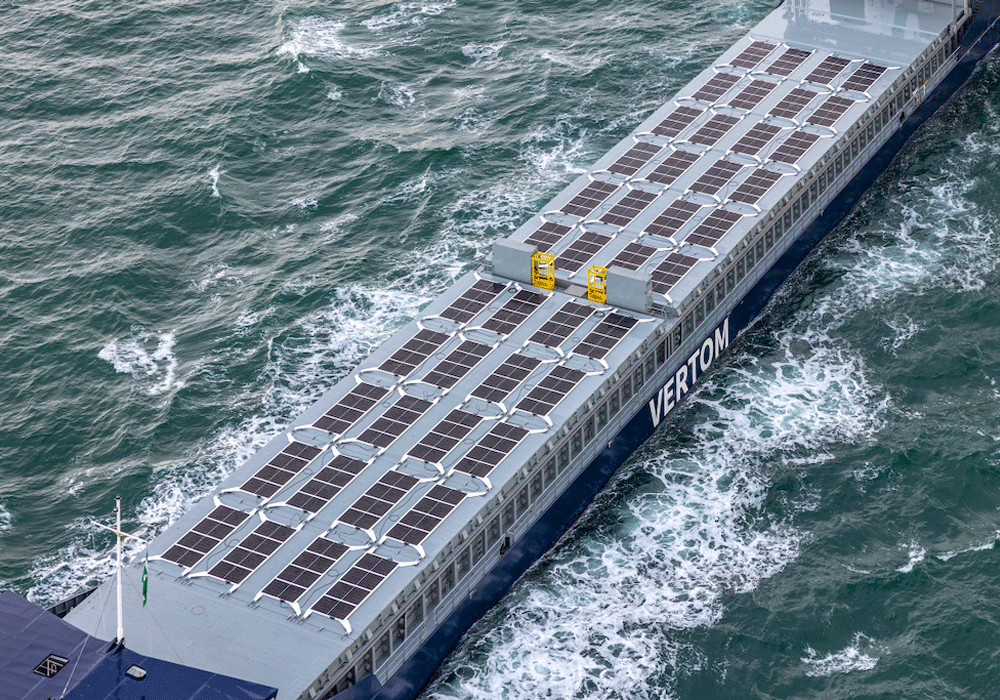
Wattlab's first full-scale installation on a seagoing vessel, the Vertom Tula (image: Wattlab)
There has been a relatively low uptake of solar in shipping, which, if one considers the extent to which it has rapidly expanded on shore, is a surprising realisation.
Coupled with cheaper battery production, new solar grew enough to meet all power-demand growth on land globally in 2025, according to global energy think tank Ember.
But at sea, progress has been considerably slower, limited to a handful of working prototypes. Over six months, Mahi Two, a tiny autonomous boat, made a 4,300nm crossing from Spain to Martinique on solar power alone, ending its crawling six-month voyage in April 2022.
In 2025, Silent 62, a pleasure yacht, crossed from Gibraltar to Antigua, 3,800nm using 72% solar power. To put this into perspective: