

Wind Propulsion 2026 overview: Momentum meets method
27th Feb 2026
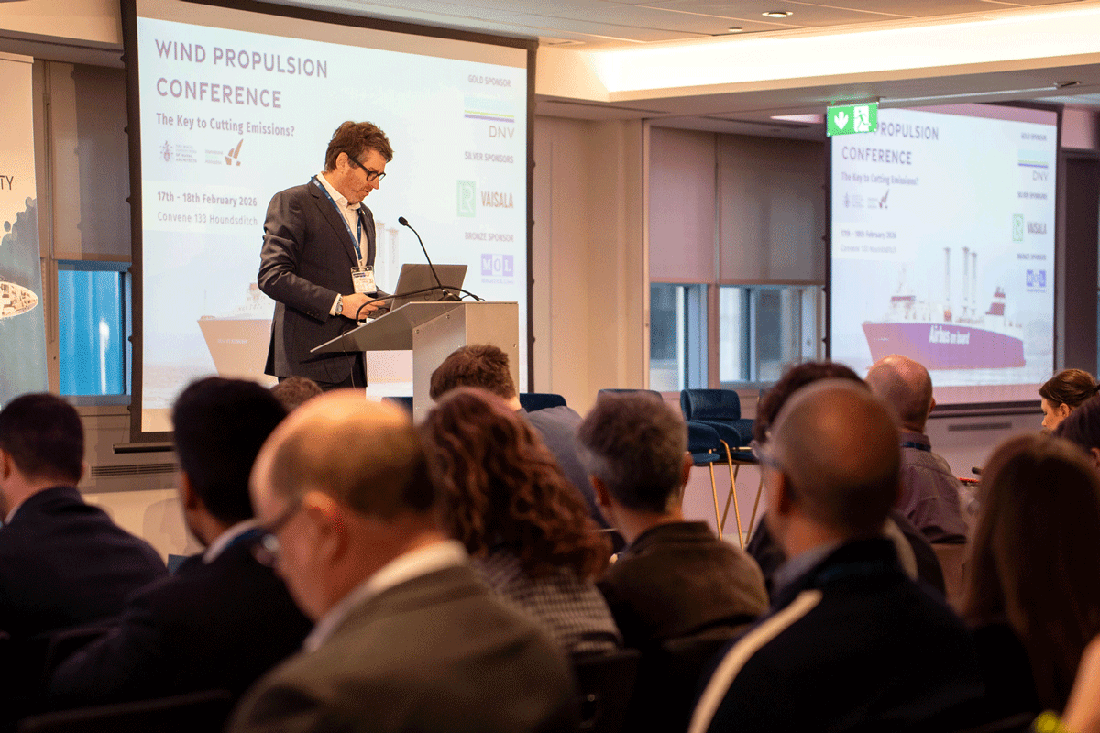
Pictured, RINA CEO Paul Jobson takes the stand at the Institution's sold-out Wind Propulsion 2026 Conference
“It’s the only propulsion solution that actually pays for itself.”
The statement made by Gavin Allwright, Secretary general of the International Windship Association (IWSA), during his keynote speech at the Royal Institution of Naval Architects (RINA) Wind Propulsion 2026 Conference captured the commercial logic increasingly underpinning wind-assisted propulsion (WAPS).
Held on 17–18 February at Convene 133 Houndsditch in the City of London, the conference opened to a sold-out audience, a clear signal of the growing centrality of wind propulsion within maritime decarbonisation strategy.
Hosted by the Royal Institution of Naval Architects (RINA) in association with the IWSA, the event continues to serve as an important early-year marker in the decarbonisation calendar, setting context ahead of further debate at gatherings such as RINA’s Ship Energy Efficiency Conference in Athens.
Gold sponsorship came from DNV, with silver sponsors including Lloyd's Register and Vaisala, underscoring the degree to which wind propulsion is now embedded within mainstream classification, verification and risk management frameworks. Bronze sponsorship was provided by Mitsui O.S.K. Lines.
An underlying theme across the first day of the conference was the industry’s response to the recent impasse at the latest MEPC meeting at the International Maritime Organization (IMO). However, while a hoped-for consensus on mid-term greenhouse gas measures was not reached in 2025, conference attendees were optimistic that it would not prevent wind-propulsion technology from developing apace.
In one of the conference’s opening speeches Aakash Dua, Regional Business Development Director at DNV, framed the broader challenge that new fuels and technologies are introducing uncertainty into the system, but that also provides new opportunities to evolve. Decarbonisation, he argued, is not a “chicken and egg” dilemma but a full-system transformation requiring early dialogue rather than competition between sectors. The pathway must be “safe, scalable and irreversible.”
Maintaining course
That framing set the stage for the keynote from David Osborn, Director, Marine Environment Division, IMO, whose remarks carried particular weight given the recent regulatory turbulence.
Recalling advice from his time at naval college in Australia, Osborn stated that the maritime sector must “remain flexible, and roll with the punches.” He addressed concerns that policy momentum might be faltering. “Wind has not gone out the sails of decarbonisation in the maritime sector,” he insisted. “Progress continues, we must keep our focus on action.”
While acknowledging that turning policy into practice cannot rest with one organisation alone, he pointed to the IMO’s track record of delivering tangible outcomes through regulation. The organisation remains technology agnostic, he stressed, but “concrete action to reduce emissions can be undertaken now,” as demonstrated by accelerating technological deployment.
The message was one of continuity amid recent disruption. “We must maintain our course.”
In the technical streams, presentations examined verification methodologies, digital twins and performance modelling, all essential for translating projected savings into bankable outcomes. The integration of wind systems into hull design, manoeuvring standards and structural assessments featured prominently. Post-presentation panel discussions agreed that as installations scale, wind devices must be treated as part of vessel architecture rather than appendages.
Policy and regulation
The Policy and Regulation roundtable that followed also revealed a more candid assessment of the current moment.
Chaired by Stefano Scarpa, Director of Maritime Decarbonisation, ABL Group, the discussion began with what he described as the “big shock” of the most recent MEPC meeting. Regulations had not been approved; consensus had fractured. Yet, he argued, work on practical implementation must continue regardless.
Decarbonisation is a matter of “when, not if,” argued David Connolly, Head of Operations, UMAS, who also suggested the outcome of the previous MEPC meeting was less surprising than some perceived. Connolly stated that while the regulatory trajectory may be uneven, directionally it remains clear.
John Taukave, Policy Advisor, Micronesian Centre for Sustainable Transport, provided a stark reminder of the stakes: “Every delay is an existential delay for the communities of the Pacific.” He made it clear that for small island developing states, wind propulsion is not merely a commercial efficiency tool but part of a broader zero-carbon transition framework, and one that also reconnects with long maritime traditions of wind-powered navigation.
The concept of a just and equitable transition surfaced repeatedly. How does wind propulsion contribute not only to emissions reduction but also to inclusive decarbonisation pathways? The Marshall Islands’ historic and cultural relationship with wind-powered vessels was cited as a powerful symbolic and practical reference point.
Connolly argued that a “fundamental reset” may be necessary: newbuilds should be prepared for wind in the same way they are increasingly designed to accommodate alternative fuels. The implication was structural. Wind should not remain an afterthought retrofit, but a design consideration from the outset.
Parallel presentation streams throughout the first day demonstrated that scaling wind propulsion requires more than aerodynamic efficiency.
Legal and contractual risk
Elsewhere, legal and contractual risk was scrutinised. Professor Orestis Schinas, Specialist in Ship Finance, HHX.blue, chaired a roundtable exploring how construction contracts, charterparty arrangements and insurance frameworks must evolve.
Dr Pia Rebelo, Legal Analyst, Stephenson & Harwood, noted that contractual obligations will require reshuffling as wind propulsion becomes embedded within design and regulatory compliance. New areas of risk, performance guarantees, downtime exposure, repair logistics, must be allocated clearly.
The complexity of maritime contractual relationships, voyage charters, time charters, sale contracts, bills of lading, remains “incredibly antagonistic” in places. Introducing new propulsion technologies adds further friction.
François Luigi, Client Director, Filhet Allard, observed that insurers do not fear risk; they fear uncertainty. The challenge lies in limited repair infrastructure, sparse spare parts networks and geographically dispersed manufacturing. Data, therefore, becomes central to risk assessment and premium stability.
Delivering measurable savings
Gavin Allwright’s keynote on the morning of the second day placed wind propulsion within a pragmatic commercial frame. Ninety-three large vessels are now operating with wind systems, representing around 5 million dwt, with a further 120 installations in the pipeline, the majority expected in 2026. The sector, he suggested, is “rapidly approaching an inflection point,” where operational data, production capacity and commercial familiarity begin reinforcing one another.
Framing wind not as a novelty but as continuity, he observed, “we are coming back to an energy source that has been there forever, we’re just doing it better.” At the same time, he was clear that integration matters: “If we take energy efficiency, voyage optimisation and wind together, cumulatively, we’re getting close” to longer-term decarbonisation targets.
“If the shipping industry doesn’t see a way to make money, these will fail,” he cautioned. But, wind propulsion’s distinguishing feature is its ability to deliver measurable savings now, he stated, layered alongside CII compliance, FuelEU Maritime incentives and EU ETS exposure.
The Shipowners’ Debate, overseen by Dimitris Monioudis, Technical Committee Chair, INTERCARGO, reinforced that this is no longer theoretical.
“It’s quite complex to really put the two lines under the answer of how much you’re saving,” observed Jan Opedal, Project Manager, Odjfell Tankers, who described a decarbonisation journey rooted in fuel efficiency long before regulatory compulsion intensified. With incremental measures largely exhausted, suction sails were introduced as a next step. Yet quantifying savings precisely was noted as still being complex.
Union Maritime’s, Commercial Performance Manager, Jesse Bryce described a portfolio approach across vessel classes, embedding flexibility into newbuild foundations. “If things look good, the price looks good, the performance looks good, and we can get it on the ship, why not?,” he stated.
Keeping sights on safety
Concluding the conference, the roundtable on safety and hazards reinforced that scaling must not outpace safeguards.
Where the panellists explained that crew require understanding of wind dynamics; simulator training and updated company procedures must align with regulatory development. Again, focus was placed on the IMO, which faces a deadline to produce a dedicated safety code for wind-assisted propulsion, and has acknowledged gaps in expertise. Collaboration between class, insurers and owners was also emphasised as essential.
Redundancy, including retention of conventional propulsion systems, was framed as reasonable and necessary. Commercial realities, cargo considerations and operational risk must be balanced carefully.
Wind Propulsion 2026 demonstrated the scale and industrial growth of the segment within the maritime sector, technically, commercially and institutionally. While regulatory uncertainty remains, deployment across the global fleet continues.
The narrative has shifted from “if” to “how”.
As Osborn cautioned, maintaining course matters. But as Allwright argued, commercial logic must underpin ambition.
